
 16 min read 28th May 2026
AI has become part of how we communicate. But a lot of people are still slightly cautious of it, and understandably so.
While it might sound like a human, it doesn’t think or feel the way we do. It also doesn’t truly know your audience, the context, or the stakes in the room.
At Body Talk, we’ve spent over 20 years helping people communicate more effectively in real-world situations. So let’s look at where AI genuinely helps you to develop your communication skills, and where human expertise is needed.
What makes communication skills so important?
A lot of people wonder if communication skills still matter in the age of AI, where you can ask a chatbot to draft a professional email and get it back in seconds.
But communication skills matter as much as ever. Just a few of the outcomes strong communication drives are:
Productivity
When employees understand their roles and expectations, they work more efficiently, leading to quicker turnaround times and higher output. In fact,64% of business leaders in The State of Business Communication 2024 report said that communication directly improved their team’s productivity.
Innovation
This is key when you need fresh thinking to stay ahead of the competition. Good communication helps teams stay in sync, and that leads to better results across the board.
Strong relationships
Businesses that communicate well with their clients end up with stronger relationships, repeat business, and referrals. At the end of the day, happy clients are loyal clients.
Better leadership
Leaders who communicate clearly are better at gathering input from the team, understanding what’s working, and making decisions that move the business forward. When leaders communicate well, it also builds trust within the team – people are more likely to follow leaders they understand and believe in.
Employee retention
When employees know what’s expected, feel heard, and can give feedback, they’re more invested in their work. Open communication helps keep people motivated and makes them feel like they’re part of something important. Engaged employees are more likely to stay with the company, which means lower turnover and less time spent hiring and training new staff.
Positive brand reputation
Communication doesn’t just happen inside the company, it impacts how your brand is seen by the public. Whether it’s how you handle a customer complaint or the way you announce a new product, clear communication helps build trust with your customers and the outside world.
How can AI help you develop your communication skills?
AI is changing how people build communication skills by making practice easier, faster, and more accessible. Instead of waiting for a workshop or feedback from a manager, you can now practice anytime and get instant input on how you’re doing.
AI-powered communication training uses tools like virtual assistants, speech analysis software, and AI chatbots to simulate conversations or analyse your communication skills. It’s often used for:
- Public speaking: AI tools can analyse how you speak – your pace, tone, clarity, and even how often you use filler words like “um” or “uh.” AI can also support you behind the scenes with creating presentation slides, or writing a script. We go into balancing this with your own human experiences and creativity in our blog on using AI for business presentations.
- Written communication: Writing is one of the easiest areas to improve with AI. Tools can instantly flag unclear sentences, suggest better phrasing, and help you adjust tone depending on your audience.
- Nonverbal communication: Some AI tools now analyse video to give feedback on eye contact and facial expressions. This is especially useful for presentations, interviews, and client calls. While it’s not perfect, it can highlight habits you might not even realise you have, like avoiding eye contact or looking disengaged.
Popular AI tools for communication training
There’s a growing number of AI tools designed specifically to help with communication skills. A few well-known examples include:
- Grammarly: Helps improve written communication by suggesting clearer phrasing, correcting grammar, and adjusting tone based on your audience.
- VirtualSpeech: Focused on public speaking and presentation skills, using AI and simulations to help you practice in realistic scenarios.
- VoiceVibes: Analyses your speaking style and gives you detailed feedback to improve.
- Microsoft PowerPoint’s AI-powered features like Rehearse with Coach: Gives feedback on pacing, tone, filler words.
- Microsoft CoPilot for PowerPoint: Helps you quickly generate slide decks.
Strengths of AI for communication training
Why are individuals and businesses across the globe using AI?
- Repetition & practice: One of AI’s biggest advantages is volume. You can practice again and again without needing anyone else’s time.
- Affordable & scalable: AI tools may be more cost-effective and can be used by individuals or entire teams at scale.
- Personalisation: AI can track your progress, identify patterns in how you communicate, and tailor feedback based on your specific strengths and weaknesses.
Limitations of AI for communication training
While AI is great for building core skills, it has clear limits, especially when communication becomes more nuanced and unpredictable.
- Relies on predictability: Real conversations don’t always look like AI practice sessions. People interrupt, change direction, react emotionally, or say things you don’t expect. AI simulations are improving, but they still can’t fully replicate the unpredictability of real human interaction.
- Limited creativity: If you’re using AI to help you practice for a presentation and you want to develop ideas alongside it, you might find some limitations to its creativity. AI can be great at helping you get started. But over time, it can actually limit how far those ideas develop. A 2024 study found that while joint human-AI teams produced strong ideas early on, creativity tended to plateau over time. In contrast, human-only teams kept refining and improving their ideas across multiple rounds.
- Lack of emotional intelligence: When you’re practicing through AI, you’re often typing or speaking into a tool – not dealing with a real person – so you lose the natural back-and-forth, body language, and emotional cues that matter in real conversations. This becomes a major gap in situations that require emotional awareness, like giving tough feedback or handling conflict. We go into the research behind this in our blog post on the communication skills AI can’t replace.
AI vs communication training: can artificial intelligence match professional communication training?
Let’s go through how artificial intelligence and professional communication training compare.
Realism
A 2025 study in JMIR Medical Education found that AI communication tools are highly effective for practice. Users reported strong engagement, high motivation, and real improvement through repetition and instant feedback. But the same study also showed that AI only achieved moderate realism, with clear gaps in emotional depth and nonverbal communication (facial expressions and body language).
Working with human specialists gives you something AI can’t replicate: real interaction and the experience of helping hundreds of people with similar challenges.
You might find value in using AI as a practice partner, but you’re likely to find more value in developing these essential communication skills through professional, science-backed communication training.
Accuracy of information
There’s also a trust factor to consider. AI is incredibly knowledgeable, but it doesn’t always distinguish between what’s scientifically proven and what’s simply widely shared online. Communication training, by contrast, should always be built on established research and proven methods.
Convenience
While AI is often seen as the more convenient option, training today isn’t limited or inconvenient. You can access our training courses at Body Talk in a range of formats, for example:
- In-person workshops for hands-on, real-time feedback
- Online coaching for flexibility without losing human interaction
- Self-paced eLearning for structured development at your own pace
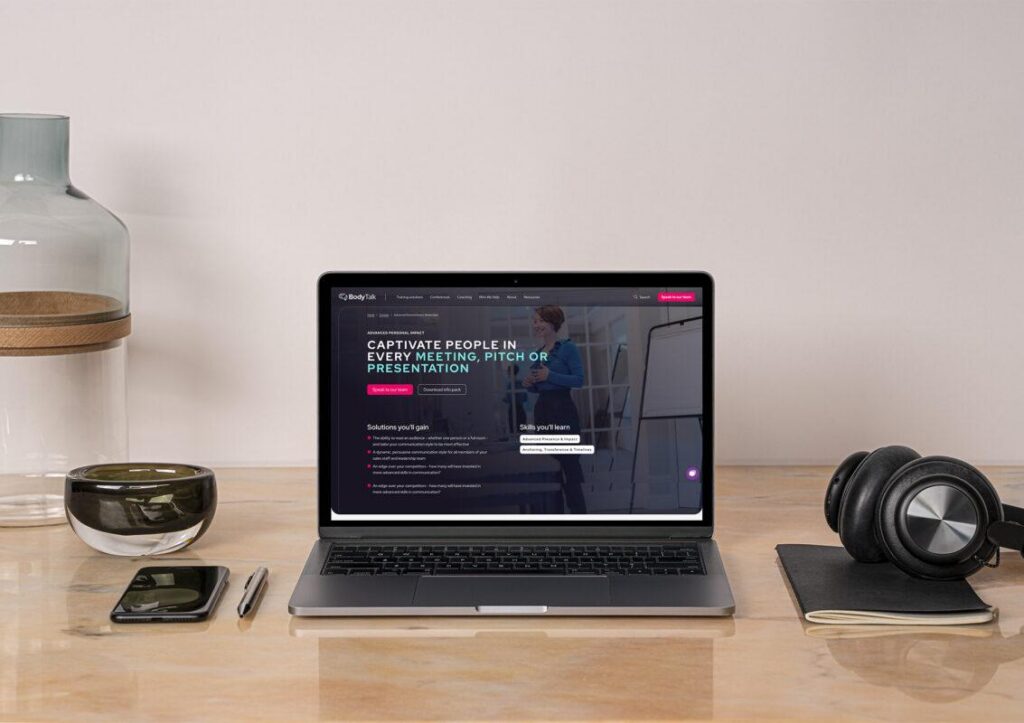
Gain skills you can use straight away with science-backed communication training
At Body Talk, everything is built around real moments. Difficult conversations, high-stakes pitches, and messages you need to land first time.
The Body Talk Way, developed over 20 years of research, gives you skills you can use immediately and keep building on. You’ll work with world-class trainers with backgrounds in national media, film, and stage – focused on the specific communication challenges you’re facing.
Choose from courses on:
- Influencing decisions through storytelling techniques
- Handling objections with confidence
- Resolving conflict constructively
- Communicating with impact in high-stakes situations
- Giving feedback that drives real improvement
- Leading teams with authority
- Strengthening your personal impact in every interaction
Explore the full range of communication skills courses and start seeing the difference in how you communicate.

Frequently asked questions
We’ve covered your most common questions below.
How can marketing and communication professionals leverage AI?
You can use AI and communication technologies to support everything from idea generation to execution. Tools can quickly produce AI generated content for external communication, including social media posts, campaign messaging, and first drafts of marketing materials.
However, AI driven content creation works best when it’s guided by strong human input. AI has a basic understanding of language and patterns, but it doesn’t truly understand your audience, brand nuance, or the intent behind your communication strategies. That’s where your expertise is needed.
The most effective approach is to treat AI like a junior team member: skilled but still reliant on you to make strategic decisions and ensure everything aligns with your audience and goals.
Can AI help with critical thinking and decision-making?
AI powered tools can support critical thinking by helping you to analyse data and explore different perspectives – giving you a deeper understanding of complex situations. This can be especially useful in areas like crisis management.
Keep in mind that it’s important to stay critical when leveraging generative AI. These tools use natural language processing to produce responses that sound natural and persuasive, even when the underlying information may be incomplete or not entirely accurate.
Used well, AI can sharpen your thinking, but it shouldn’t replace it. The real value comes from combining AI’s speed and breadth of insight with your own judgement, experience, and ability to question what you’re given.
Is it necessary to use AI in 2026?
No, especially when it comes to creativity and communication. These are areas where being distinctly human is still your biggest advantage, and where you can truly stand out.
That said, there are benefits to using AI in the right ways. It can speed up repetitive tasks, help analyse customer behaviour, and give you a competitive edge when used thoughtfully. Understanding how AI works at a basic level and building your AI knowledge means you can recognise where it adds value without becoming overly reliant on it.
What are some real-world examples of AI use?
AI shows up in a wide range of real-world applications, often in ways we interact with daily. Many people are familiar with customer service chatbots.
AI is also increasingly used in marketing. For example, Coca-Cola’s 2024 AI-driven campaign demonstrated how brands can integrate AI into creative production at scale – but it also received backlash, highlighting the risks of losing authenticity when using AI.














 Back
Back