
 19 min read 22nd Jun 2026
Before humans developed language, we relied on gestures, expressions, and movement to communicate. Even today, body language allows us to convey meaning across language barriers.
However, when people step in front of a room full of people to speak, many struggle with their nonverbal communication. It’s common to see speakers make themselves small and freeze, or, on the opposite extreme, pace and fidget.
Having conducted one of the world’s largest studies on nonverbal communication, we’re passionate about the science behind communication at Body Talk. In this guide, you’ll learn actionable tips for mastering body language in presentations, both in-person and online.

Why is body language so important for presentations?
When it comes to communication, people often trust body language over spoken words. In fact, your audience’s brain processes visual information faster than verbal information – the optic nerve is one of the largest nerve bundles in the body, and it’s constantly picking up cues from posture, gestures, and facial expressions. This means that your body language can have a bigger impact than your spoken words.
Before you step on stage, consider how you want your audience to feel and what impression you want to leave. Then, consciously align your body language to reinforce that feeling. Confident posture, intentional gestures, and purposeful movement all help keep the audience’s attention on your message rather than on distractions or mixed signals.
Nonverbal cues for effective presentations
These are the essential cues that make your presentations come alive. We’ll discuss how to use them effectively in the tips ahead.
- Hand gestures
- Eye contact
- Posture
- Movement
- Facial expressions
- Voice and tone integration
6 tips to improve your body language in presentations
These body language tips will help you improve your presentation skills by making your communication clearer, more confident, and more engaging.
1. Use a strong presentation posture
Remember that your posture sets the tone for what you’re about to say. Think of someone acting Clark Kent versus Superman: it’s the same person, but the difference in posture transforms them from someone blending into the crowd to a superhero.
Many speakers unconsciously shift their weight onto one leg, lean to one side, or rock back and forth. This may feel comfortable, but it actually signals insecurity to both you and your audience. Again, think Clark Kent vs Superman.
Instead, stand tall with your feet shoulder-width apart and lift your sternum. This stance grounds you physically and helps you feel centred. Gravity works for you instead of against you, so you feel more present and in control.
From the moment you step on stage, this is one of the most effective ways to project positive stage presence and start gaining your audience’s trust.
2. Focus on your audience
Many people believe they can’t use gestures or body language effectively, but this often comes from feeling self-conscious in front of an audience. You probably find that you gesture naturally when you’re speaking to family and friends, because you don’t feel that same pressure to perform.
A simple way to break out of this self-conscious feeling is to intentionally move your focus onto the audience instead.
What do they need from you? What have they come to learn? How are you going to help them?
The moment your attention moves outward, it becomes much easier to relax and let your body language flow naturally. You can find out more about how to put your focus on your audience in our blog on preparing for a presentation.
3. Be intentional with your hand gestures
Start moving your arms as you begin speaking, ideally on your first word. This helps break the initial tension you may be feeling and signals to your body that it’s safe to move. Once you’re in motion, it becomes much easier to stay relaxed and natural throughout your talk.
So how should you use gestures effectively? Let’s break it down.
- A common mistake is keeping your arms glued to your sides in what we call a “T-Rex pose.” This restricts your movement and makes your delivery feel closed off. Instead, keep your elbows slightly away from your body to create space and openness. Palms facing up can feel welcoming and open, while palms facing down can help reinforce a stronger, more grounded statement.
- Use purposeful gestures when they naturally align with your speech, especially when you want to emphasise key points or illustrate an idea.
- When you’re not gesturing, simply let your hands rest by your sides. This neutral position is better than falling into nervous habits like fidgeting, clasping your hands tightly, or repeatedly adjusting clothing.
4. Maintain eye contact
Eye contact helps create connection. It makes your audience feel included in the conversation and shows that you are engaged with them, not just delivering information at them.
Rather than scanning the room or looking above people’s heads, try to connect briefly with different individuals around the audience. Holding eye contact for a sentence or thought can make your delivery feel more natural and conversational.
That said, it’s important to recognise that eye contact is not comfortable or natural for everyone. With greater awareness of neurodiversity, we understand that some speakers may find sustained eye contact distracting or overwhelming. The aim is not perfect eye contact, but genuine connection and presence.
Audiences respond far more to authenticity and engagement than to rigid presentation rules.
5. Match facial expressions to your message
In a large study, Vanessa Van Edwards had 760 volunteers watch hundreds of TED Talks and rate the speakers on various qualities. After collecting all the ratings, she analysed the results to identify patterns in nonverbal communication.
One of the key findings was that the longer a speaker smiled, the higher they were rated in perceived intelligence. In other words, your facial expression doesn’t just affect how likeable you seem – it can also affect how competent you appear.
A great way to see this in action is to observe strong speakers. As an example, let’s look at this TEDx Talk by our founder, Richard Newman. Notice how his expressions change naturally throughout: from light and relaxed, to smiling, to more inquisitive or reflective moments depending on the message. Even when discussing more vulnerable topics, his tone and facial expression remain open and composed rather than heavy or closed.
You can learn a lot by watching other speakers in the same way. Pause, observe their expressions at different moments, and reflect on how those changes support what they are saying.
6. Move strategically
Before you move, pause and ask yourself: do you really need to? It’s common for new speakers to pace around the stage out of nerves or just because they think they should. Unfortunately, this can become a distraction for your audience.
Run through your speech a few times and notice where you feel the impulse to move. If you feel a natural burst of energy or emphasis, it can work well to take a few steps to match that moment. Movement can help bring dynamism to your delivery when it’s intentional.
However, for key messages, always return to a grounded, centred position so your audience can focus fully on what you’re saying.

Common body language mistakes to avoid
Even strong content can lose impact if your delivery doesn’t match it. Avoiding these habits will help you maintain positive body language and keep your audience focused on your message, not your mannerisms.
Slouching or looking uncomfortable
When you slouch, shrink your posture, or appear uneasy, your body speaks louder than your words. Even if your content is strong, your audience may read uncertainty.
Closed body language
Crossed arms, hands in pockets, or a tight, guarded stance can all signal discomfort. Even if you don’t feel nervous, these habits can create distance between you and your audience and make you appear less open.
Body language in virtual presentations
Audience engagement is one of the main things speakers struggle with when presenting online. Without a physical room, your physical presence is reduced, which means your body language has to work even harder to maintain the connection.
Because there’s less of you visible, every detail matters more. So, how can you be more intentional in your body language when giving a virtual presentation?
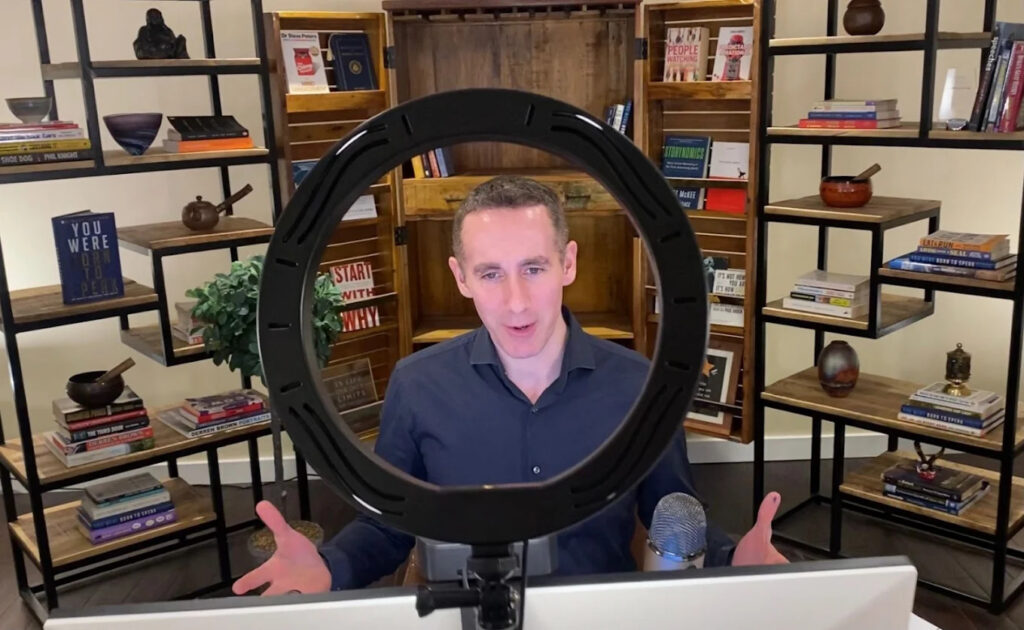
Make eye contact with the webcam
Look directly into the webcam when speaking, especially during key points. This creates the feeling of direct eye contact with your viewer.
Sit up straight and stay open
Maintain good posture by sitting upright with your arms free and relaxed. Observe how news anchors or game show hosts present on television and how they keep you, the viewer at home, engaged.
Speak to one person, not a crowd
Most people watch content alone on a phone or tablet. That means you’re effectively speaking to one individual. Avoid breaking that illusion by saying things like “hello everyone.”
Instead of imagining a large audience, picture one specific person you’re talking to, ideally someone you know or feel comfortable with. As well as helping you to relax, this will help your tone to become more personal.
Combining body language and vocal delivery
When your body language, voice, and content work together, it becomes much easier for your audience to become convinced by what you’re saying. Let’s go into why that is.
Why voice and nonverbal cues work together?
Imagine someone telling you they’re not angry, but they won’t look at you. Or someone saying they’re excited to see you, but they’re looking down at the floor with a monotonous voice. In both cases, the message doesn’t feel believable.
That’s because your voice and your body language need to reinforce each other. When they’re misaligned, it creates poor body language signals that undermine trust and make your message harder to believe, no matter how good your words are.
Exercises to become congruent
One of the most effective ways to improve this is to record yourself presenting. Watch it back and look for moments where your voice and body don’t quite match – these are often things you’re completely unaware of in the moment.
If the idea of recording yourself feels uncomfortable, you’re not alone. Many people avoid it at first. But it’s one of the fastest ways to improve. It helps you become more aware of how you actually come across, and it also gets you used to hearing your own voice, which builds confidence over time.

Empower your people with presentation skills training
Do your team’s presentations sometimes fall flat despite having great ideas?
Are nervous habits stopping them from making a lasting impression?
With over 20 years of experience coaching businesses and a science-backed framework, our presentation skills training courses are hands-on and energising. You’ll notice the difference from the end of your first session as your team practices and experiments with our world-class coaches.
What can you expect?
Learn how to…
- Engage every audience with six essential effective body language techniques.
- Use your voice properly with advanced methods used by actors and broadcasters.
- Create persuasive messages with the GRID method, a proven system for storytelling, structure, and persuasion.
- Handle any question confidently with our ECPC technique.
- Master influence by applying the psychology behind great advertising to presentations.
Learn more about the presentation training courses.
Frequently asked questions
We’ve answered your most frequently asked questions below.
How can I stop fidgeting when I present?
Fidgeting is usually just nervous energy with nowhere to go. The key is not to remove movement, but to replace it with intention. Slow down your delivery so your body has time to stay controlled and steady.
Give your hands a purpose. Plan simple gestures in advance – like open palms or palms-down movements for highlighting key points – so you’re not relying on nervous habits in the moment.
You can also mentally rehearse your delivery. Visualise yourself standing with calm, open body language, using controlled, purposeful gestures. This kind of mental preparation reduces anxiety and helps your body feel more familiar with the idea of presenting confidently.
What is the best way to stand when public speaking?
The best stance is one that feels grounded, open, and intentional. Stand with your feet about shoulder-width apart to create stability and avoid shifting your weight from side to side. A slight bend in the knees helps you stay relaxed and prevents you from looking rigid or locked. To create more connection, lean slightly forward from the ankles when speaking.
Above all, your stance should support your unique presentation style – something that feels natural to you while still projecting confidence.
How can I overcome nerves before a presentation?
Start by focusing on your breathing – specifically, a slow, controlled exhale. This helps calm your nervous system and brings your attention back into the present moment.
Next, draw confidence from experience. Think back to similar situations where you’ve spoken successfully or handled pressure well. Reminding yourself of past wins helps reframe nerves as excitement and prepares you for a successful presentation.
It also helps to remember that almost all human beings experience nerves before speaking – it’s a normal response, not a flaw. Even experienced speakers feel it. The difference is how they manage it.
For more techniques on calming your nerves and building confidence before you speak, take a look at our guide on how to calm down before a presentation.














 Back
Back