 17 min read 16th Mar 2026
With virtual networking and video calls now part of everyday professional life, we have access to more people – and more opportunities – than ever before.
But connecting through a screen brings its own challenges. Without physical presence, it’s harder to read subtle cues. Small shifts in posture, breath, energy – the signals we instinctively rely on in person – are less visible. And your brain notices that distance, even if you’re not consciously aware of it.
At Body Talk, we’ve spent over 25 years exploring the science behind communication – understanding not just what works, but why it works. In this blog, we’ll share the small, practical adjustments that can transform how you come across online.
So that even through a screen, you feel present. Confident. And genuinely connected.
What is virtual networking?
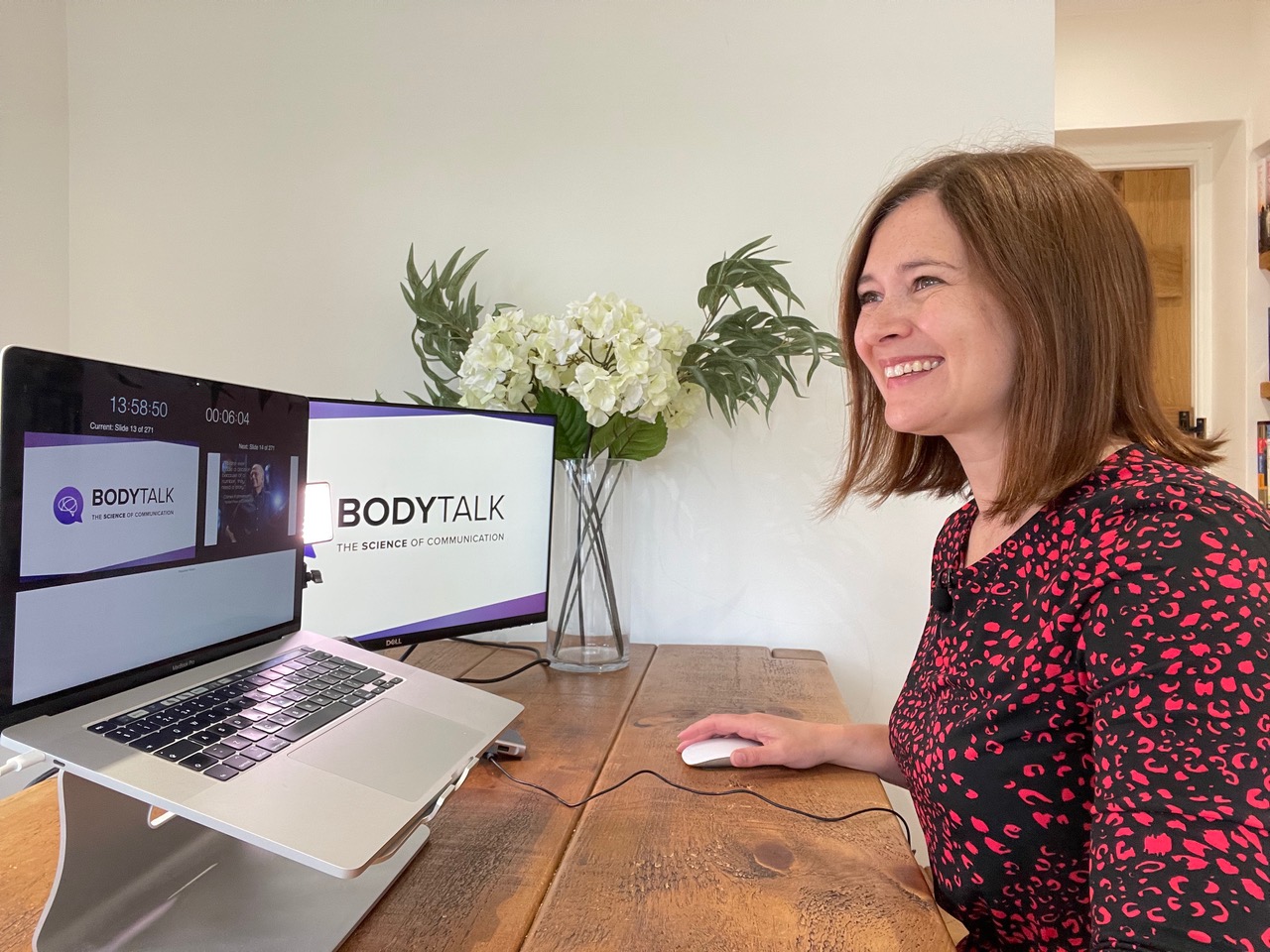
Virtual networking is the online equivalent of face-to-face business networking. Any time that you make a business connection using an online platform, like Zoom, Teams, LinkedIn, or even email, you’re taking part in virtual networking.
Face-to-face and virtual networking are best used together. Virtual networking provides a great way to keep in touch with people you meet at in-person networking events. Likewise, you can also meet people at virtual events and then arrange to meet face-to-face later to continue building the relationship.
Examples of virtual networking
- One-to-one online meetings – like meeting for a coffee, but you might have to bring your own in this case!
- Online events hosted on Zoom or Teams, usually by organisations.
- Social media platforms like LinkedIn and Facebook, where you can interact with other peoples’ posts and send messages to them to express interest in their work.
- Podcasts or blogs that you can feature as a guest on.
Finding the right networking style for you
One of the advantages of virtual networking is that it gives you options.
If you find large, in-person events tiring, online networking can feel more manageable. You’re in a familiar environment and you can control your space. For many people – particularly those who consider themselves more introverted – that sense of control makes it much easier to show up as their best self.
But it’s important to remember: being introverted does not mean you can’t network confidently in person.
In fact, many introverts are excellent networkers. They tend to listen carefully, ask thoughtful questions, and prefer deeper one-to-one conversations over surface-level small talk. Those are strengths, and they translate into both virtual and face-to-face settings.
If you’d like more support with navigating physical networking spaces, we explore this in our blog on networking as an introvert. The aim isn’t to choose one format over another, it’s to recognise that you’re capable of both.

How to start networking online
If you’re new to online networking – or it just hasn’t felt natural so far – knowing where to begin can feel like the hardest part. The good news is that getting started doesn’t have to be complicated.
Professional social media and your personal brand
Think of your professional social media profiles as your digital introduction, especially for LinkedIn. If someone meets you at an event and looks you up afterwards, will they quickly understand what you do and who you help?
Once that foundation is in place, it’s really about showing up in a way that feels natural to you. That might mean sharing a perspective drawn from your own experience, or adding your thoughts to a post that genuinely made you pause and think. It could be asking a question that invites discussion rather than trying to make a point.
Over time, those small interactions build familiarity.
Look for networking events in your industry
Many organisations now host virtual networking sessions alongside in-person events. Some are informal and discussion-based. Others focus on education, with presentations and structured Q&A sessions.
Think about what you need right now. Are you looking to learn? To collaborate? To explore potential partnerships? Choosing events that match your intention makes the experience feel purposeful rather than random.
What to expect from virtual networking events
Just like face-to-face networking, there are different types of virtual events.
- Some are designed mainly for meeting people. You’ll usually be placed into small breakout rooms with a handful of others and given a few minutes each to introduce yourselves. The structure means everyone gets a turn, which often takes the pressure off.
- Other events are more focused on learning. There might be a speaker or panel discussion, followed by a moderated Q&A. In these settings, you can choose how much you participate – whether that’s asking a question, contributing in the chat, or simply listening and taking it in.
One difference you’ll probably notice is that virtual events tend to be more structured than in-person ones. There’s usually a clear schedule and the host will guide you through what’s happening next.
Of course, every event follows its own rules. A quick glance at the event page will usually tell you what to expect, which can help settle any pre-event nerves.
Tips for virtual networking events
Attending virtual networking events can feel a bit strange at first – you’re at home, you’re on a screen, and you can see your own face the whole time.
These tips can help you bridge that gap. They’ll show you how to create presence and build connection, even when you’re not physically in the same space.
Avoiding technical issues
Before attending an event, give yourself a few minutes to check your setup. Test your camera and sound, make sure your internet connection is stable, and let others in your home or office know you’ll be in a meeting so you’re unlikely to be interrupted.
- Think about what the other person will see. Position your camera at eye level so you’re not looking down at the screen, and make sure your face is clearly lit. If you’re sitting with a bright window behind you, your expressions can become difficult to read, which makes connection harder than it needs to be.
- Sound quality matters just as much. Built-in laptop microphones often flatten or distort your voice without you realising it. A small external or clip-on microphone can make your voice sound clearer and more natural, which allows people to concentrate on what you’re saying rather than how it sounds.
- If you’re hosting a one-to-one networking call, try to make the process straightforward for the other person. Send clear joining instructions and familiarise yourself with the platform in advance. Removing small sources of friction helps the conversation begin on a positive note.
Use gestures
It’s surprisingly easy to become very still on camera. But your body still plays an important role in how you’re perceived.
Look into the camera when you’re speaking so the other person feels directly addressed, and allow yourself to gesture naturally.
As we discuss in our blog on the power of gestures in virtual communication, gestures don’t just make you look more animated – they actually influence how you sound.
In May 2020, Wim Pouw of the University of Connecticut published research exploring how arm gestures affect the voice. He found that the muscular tension involved in gesturing travels through the body, influencing lung pressure and therefore pitch and volume. When listeners heard recordings, they could not only hear differences in vocal tone but were even able to identify which gestures were being used.
As Pouw explains, “When you hear a voice, you literally hear aspects of a person’s entire body.”
In other words, even on Zoom or Teams, your whole body is part of the conversation.
Prepare ahead of time
Preparation helps you feel grounded. Rather than scripting every sentence, think about how you would like to introduce yourself in a way that feels clear and conversational. The aim isn’t to deliver a pitch, but to give context and make it clear how you add value.
For example, you might say:
“I support leadership teams with communication, especially during times of change. I’m really interested in connecting with others who are working with leaders and sharing experiences.”
That gives the other person enough information to understand where you’re coming from and where the conversation might go.
If possible, you should also take a moment to review who else is attending. Knowing that you’d particularly like to speak with people in a certain role or industry gives you direction and makes the event feel more intentional.
Be curious
If you’re in a short breakout session, it’s very easy to become preoccupied with what you’re going to say next. You might be mentally rehearsing your introduction while the other person is speaking. That’s completely human.
But real connection comes from attention. Listen carefully to the words they choose and notice what seems important to them. Reflect something back – “So you’re mainly working with scaling start-ups?” – or ask a follow-up question that shows you’ve genuinely taken in what they’ve said.
Most people enter networking conversations slightly focused on themselves – how they’re coming across, what they should say next, whether they sound interesting enough. When you shift your focus onto the other person, the atmosphere changes. The conversation feels more natural and people tend to open up.
You also start to discover real points of connection – shared challenges, overlapping interests, similar experiences – and that’s where relationships begin to form.
And if the technology falters – if the screen freezes or the audio drops – don’t brush past it. Taking that moment to ask them to repeat what they were trying to say shows that you’re genuinely interested.
Follow up
This is the part people often overlook, and it’s usually where the real value sits.
After an event, it’s tempting to close your laptop and move straight on to whatever’s next. But if you had a conversation that felt genuinely interesting or easy, it’s worth taking a few minutes to follow up while it’s still fresh in your mind.
A short message is enough. You might connect on LinkedIn and mention something specific you discussed – a challenge they’re working through, a project they’re excited about, or a point that stayed with you. Referring to something concrete shows that you were present in the conversation and that you valued it.
If you’re wondering how to write the perfect follow-up message, check out our blog on how to follow up after a networking event for actionable tips and examples that work.
Ready to feel more confident networking?
If networking leaves you overthinking, second-guessing yourself, or avoiding events altogether, you’re not alone. Most people were never actually taught how to do it well – they were just told to “put themselves out there.”
That’s what we’re here to help with.
Our networking training is grounded in science-backed communication techniques, so you’re not relying on vague advice or scripts. Through our training, you’ll learn how to:
- Go into a virtual event knowing exactly how to start conversations
- Read the subtle cues on screen and adapt your communication in the moment
- Turn short breakout conversations into meaningful professional relationships
It’s time to stop dreading networking and start mastering it. Explore our networking training courses and see what’s possible.

Frequently asked questions
Let’s take a look at some common questions.
What is an example of online networking?
Online networking can take place across a range of platforms, depending on your goals.
- It can happen on social media sites such as Facebook, where conversations start in the comments or direct messages.
- It often happens on professional networking platforms like LinkedIn, where people share insights, connect after events or arrange virtual meetings.
- It can also take place in discussion forums, or event platforms like Eventbrite.
How can networking contribute to business or career success?
Over time, networking conversations give you insight into what’s happening in your industry and what business needs are shifting. You start to hear what challenges people are facing and where there might be opportunities to collaborate or contribute.
For your career, that might mean hearing about roles or projects before they’re widely advertised. For a business, it might mean referrals or partnerships that grow naturally from existing relationships.













 Back
Back