
 10 min read 16th Nov 2025
Drive along one of Queensland’s five major highways and you’ll soon come across a white and yellow road sign with a trivia question which will pique your curiosity.
“What is the highest mountain in Queensland?” or “What is a monotreme?”
If you want to check you got the answer right, you’ll have to drive on for a few kilometres until the next signpost appears.
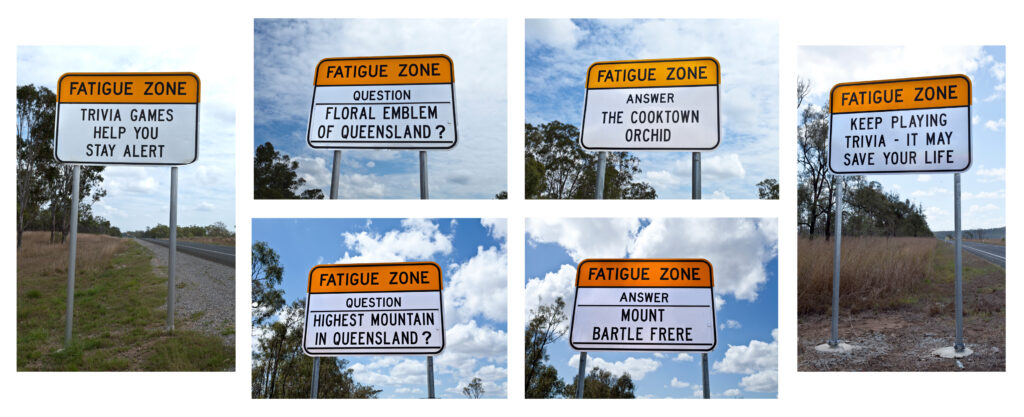
These ‘fatigue zone’ road signs were introduced in 2012 in an attempt to improve driver alertness on long journeys across the state, which is seven times larger than the UK. Long, monotonous journeys can quickly cause fatigue, but this series of question and answer signs is aimed to prevent that tiredness by keeping drivers’ minds alert and engaged.
It’s the power of curiosity in action.
And it’s a brilliant reminder of something that’s just as relevant in meeting rooms and presentation suites as it is on long, empty highways:
Curiosity wakes people up.
Why Curiosity Works So Well
The human brain can’t resist an unanswered question. We’re wired to seek completion, understanding and resolution. When we realise there’s a gap between what we know and what we want to know, attention naturally snaps towards the missing piece.
Psychologists call this the information gap, and it’s surprisingly powerful.
It’s why:
- Pub quizzes are always full
- People feel oddly proud solving Wordle before breakfast
- Cliff-hangers keep us binge-watching until far too late
- And why Queensland’s long-distance drivers perk up at a roadside trivia question
Once curiosity is sparked, the brain becomes more alert and engaged. Curiosity delivers a tiny dopamine hit nudges us back into focus – which is exactly what most presentations and meetings need.

The Real Enemy in Meetings: Predictability
If you find yourself disengaged in a meeting, it’s not because the content itself is boring – it’s often because you feel you can predict exactly what’s coming next, which causes our brain to switch off. It’s likely to be something like this:
Slide → explanation → another slide → another explanation.
Everything delivered in neat, complete, fully-explained chunks in a pattern which is entirely predictable. There’s no intrigue or uncertainty, or opportunity to wonder or guess. Predictability sends the brain drifting off – just like those long, straight Queensland roads.
Curiosity, on the other hand, pulls people in. It creates a moment where the audience switches on and leans forward – mentally or physically – because something interesting is about to be revealed.
How to Use Curiosity to Hold Attention
Here are a few practical, natural ways to use curiosity to make your communication far more engaging.
1. Start with a question instead of a statement
Queensland’s signs don’t announce facts, but they get you mentally searching for the information. You can do this in a presentation or meeting too. Instead of opening with a statement, like
“Client engagement is up this quarter.”
Try a curiosity question:
“If you had to guess which client has engaged with us most this quarter – who do you think it would be?”
No one has to answer out loud, but the act of thinking is the engagement.
2. Reveal information in layers
Mini-information gaps are a good way to pique curiosity in meetings or presentations. If you indicate that something interesting or unexpected is coming, then people are more likely to stay engaged for the reveal.
For example:
“There’s a shift in the data we didn’t expect. Before I show it to you, any guesses which part changed first?”
Even these small instances of curiosity can help to keep people concentrating for longer.
3. Bring in small, playful puzzles
You don’t need to run a full quiz to use curiosity. A light touch works beautifully.
“This is the Wordle of our Q4 numbers — three clues, you guess the theme.”
“Here’s a mini pub-quiz moment: what do you think our most misunderstood feature is?”
A tiny puzzle can create a big shift in energy.
4. Ask ‘What if?’ questions
If you’ve been on one of our storytelling courses, then you’ll already know the power of a ‘what if’ question. These prompt imaginative thinking and reawaken attention.
“What if we stopped doing X altogether?”
“What if our usage doubled overnight?”
“What would you change first if you could only change one thing?”
Getting your audience to ponder on possibilities is a positive, solutions-focused way to help people stay engaged.
5. Tell stories with a withheld detail
Stories are naturally engaging, but they work best when there’s a moment of tension or uncertainty.
“One of our teams tried something last year that almost failed… but what they learned ended up changing our whole approach.”
You haven’t even started the story yet, and you already have people’s attention.
6. Let the question breathe
A question delivered with a slight pause, a softer tone or a moment of silence lands more deeply.
It signals: This matters. Think about it.
Curiosity often lives in the space around the words.
Curiosity Doesn’t Have to Be Loud
The beauty of those Queensland road signs is their simplicity. They don’t need fancy graphics or complicated messaging – they simply offer a small invitation to think. That’s all people need in a meeting too: a reason to lean in rather than lean back.
When you build in moments of curiosity – a question, a puzzle, or a withheld reveal – you switch people from passive listeners to active participants. And active participants stay awake, engaged, and connected.
Bring More Curiosity into Your Presentations
If a tiny trivia question on a remote Australian highway can keep drivers alert for hundreds of miles, imagine what a well-placed question could do in your next presentation.
Curiosity:
- boosts attention
- increases energy
- improves memory
- and brings people along for the journey
If you’d like help in crafting presentations with expert storytelling and curiosity moments, get in contact with our team today.


















 Back
Back