 11 min read 8th Sep 2026
The Bayeux Tapestry: The 1000 Year Old Presentation We’re Still Talking About
I would love to tell you that I managed to get tickets to see the Bayeux Tapestry at the British Museum. In reality, they seemed to disappear quicker than Glastonbury’s, so I will have to admire it from afar for now.
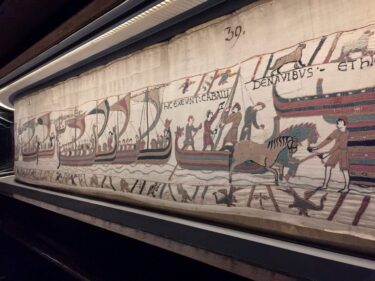
The excitement is understandable. The tapestry is being displayed in Britain for the first time since the 11th century, when it was probably made in southern England. It is almost 70 metres long and tells the story of the events leading up to the Norman Conquest through embroidered pictures and short Latin captions.
Its construction is technically embroidery, despite the famous name, so a little creative licence has already crept into the story.
It could also be seen as a very early version of PowerPoint. There is a sequence of visual scenes, supporting text and a clear message running through the whole thing. Admittedly, it contains more horses than the average corporate deck and must have been considerably harder to edit.
According to the British Museum’s guide to the Bayeux Tapestry, the story begins with Harold Godwinson’s journey to France. It takes us through his oath to William, his return to England and the events that follow his coronation. William prepares an invasion, crosses the Channel and ultimately defeats Harold at the Battle of Hastings.
It is a complicated period of political rivalry and disputed promises, yet the surviving narrative remains remarkably easy to follow.
What turns a sequence of events into a story?
Calling the Bayeux Tapestry an early version of PowerPoint is slightly mischievous, but the comparison reveals something important. Putting information into a sequence does not automatically create a story and numbering the slides certainly does not do the job.
The tapestry gives us recognisable characters whose decisions have consequences. Harold and William are not distant historical concepts. We see them travel, make promises and prepare for conflict.
Those characters also want something. As the tapestry presents events, both men have a claim to the English crown, and a crown is rather difficult to share. The audience understands the goal and can see the collision coming.
Then there is challenge. Harold’s coronation stands between William and the throne, while William must raise an army and cross the Channel. Success is never presented as effortless, which gives the narrative its tension.
The stakes could hardly be higher. The future of England is being decided, and the choices made by the central characters will cost people their lives. By the end of the surviving tapestry, the world we entered at the beginning has changed.
This basic architecture still sits underneath the stories we tell in business. We need to know who is affected by the situation and what they are trying to achieve. A challenge gives us a reason to care about the outcome, while the stakes answer the audience’s silent question: why does this matter?
Many presentations have a subject but no real story. They describe a project or explain a strategy, yet nobody appears to want anything and nothing seems to stand in the way. The audience receives plenty of information without feeling any urge to find out what happens next.
Stories are particularly effective because they help people make sense of complex ideas through human experience, as this Harvard Business Publishing article on storytelling and learning explains.
Once the central character, goal and challenge are clear, the next job is deciding which moments belong in the story.
Storytelling begins with deciding what to leave out
When people are encouraged to bring more storytelling into a presentation, they often assume they need to add something. Perhaps they need more background or another anecdote to bring the subject to life.
Very often, the presentation would benefit from having something removed.
The surviving Bayeux Tapestry is conventionally divided into 58 scenes, with a final section thought to be missing. We cannot know every decision made by the people who designed its narrative, but we can see the result: a focused journey through a dense and contested period of history.
The story keeps moving because each scene has a job to do.
That same discipline is essential in a business presentation. The audience rarely needs to know everything the speaker knows. They need enough context to understand the situation and recognise why it matters. From there, the speaker can guide them towards a conclusion.
The challenge is that leaving things out can feel surprisingly painful.
Killing your presentation darlings
Writers often refer to this process as “killing your darlings”. The phrase has been attributed to several famous authors over the years, but its earliest familiar form comes from British writer Sir Arthur Quiller-Couch, who advised writers to “murder your darlings”.
The University of Oxford’s exploration of writing and rewriting shows how much great work is shaped during the editing process. Ideas are tested and passages are removed. Sometimes an ending that once seemed perfect has to be reconsidered.
Presenters have darlings too.
There is the slide that took half a day to create, so surely it deserves to be seen. There is the fascinating piece of research that proves how thoroughly we have prepared, even though it sends the presentation off on a lengthy detour.
Sometimes the darling is a favourite story. We enjoy telling it and know that it usually gets a laugh, but deep down we also know that its connection to the subject is becoming rather strained.
The audience has no idea how much effort went into any of these things. They only know whether each one helps them follow the message.
Your presentation does not need to contain everything you know
Many presentations become overloaded because the speaker wants to demonstrate expertise. This is understandable, particularly when the subject is complex or the people listening are senior. Removing information can feel risky because the missing fact might have been the one that finally convinced them.
PowerPoint then becomes a storage facility for everything we were reluctant to cut.
Research into cognitive load and presentation design supports what most of us have experienced as audience members. When a slide contains too much information, it becomes harder to process. People start reading while the speaker continues talking, leaving the presenter to compete with their own visual aid.
The Bayeux Tapestry handles words and images rather differently. The official digital panorama from the Bayeux Museum records around 380 Latin words across the entire work. The pictures carry much of the action, while the captions help the viewer understand where they are in the story.
The visual element is doing useful work. It has not been added simply because somebody thought that section looked a little empty.
Keep the details that earn their place
Being selective does not mean draining a story of personality. Some of the most revealing details in the tapestry are found away from the kings and armoured soldiers.
We see food being prepared and animals being loaded onto ships. We also see the effect of the conflict on people who were never going to wear a crown. These smaller moments give human scale to an enormous historical event. This account of the exhibition from the Associated Press describes how scenes of domestic life sit alongside the brutality of battle.
A well-chosen detail can do the same thing in a presentation. One customer’s experience may help an audience understand a problem that remained abstract on a spreadsheet. A carefully chosen moment can make the consequences of organisational change feel real.
The detail earns its place because it brings the audience closer to the central message.
A darling sends them in another direction while the presenter shows them something they happen to like.
The embroidery test
Before finishing your next presentation, imagine that every slide has to be embroidered by hand.
Would you still include all 47 of them?
Look at each section and ask what it contributes to the audience’s understanding. If removing it makes no meaningful difference, it has probably revealed itself as a darling. If it contains useful supporting information but interrupts the flow, give it a comfortable new home in the appendix.
The physical survival of the Bayeux Tapestry owes much to careful preservation and a remarkable amount of good fortune. Its story has remained compelling because, almost 1,000 years later, we can still follow its characters through a complex moment in history.
Nobody stands in front of it wishing the creators had squeezed in a few more bullet points.















 Back
Back